
2026-09-10T10:18:28.836Z ·
How a Sub-Slab Depressurization Radon System Works (and Why It's the Standard in PA)
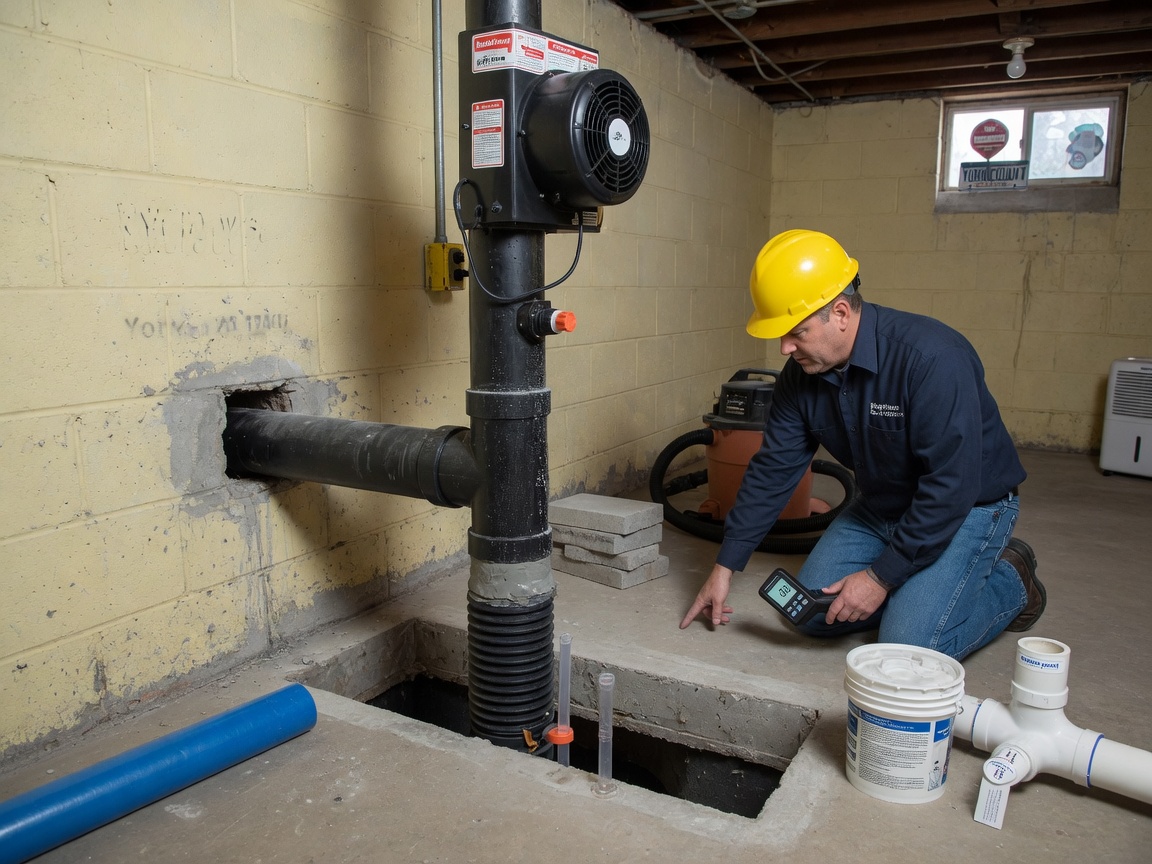
Radon gets into a house because of pressure. A heated home acts like a chimney: warm air rises and leaks out the top, and the slight vacuum that creates at the bottom pulls soil gas in through every crack, joint and pipe penetration in the slab and foundation. Sealing alone almost never works, because concrete is porous and you can't seal what you can't see. Active soil depressurization — usually called sub-slab depressurization, or ASD/SSD — works by making the pressure under the slab lower than the pressure in the basement, so soil gas is pulled away from the house instead of into it.
The system has five parts. First, a suction pit: a hole cored through the slab with a small cavity excavated in the gravel or fill beneath it, which acts as a collection point. Second, sealed Schedule 40 PVC pipe running from the pit up through the house or along an exterior wall. Third, an inline centrifugal fan — RadonAway, Festa and Fantech are the common brands — running continuously, drawing 20 to 90 watts. Fourth, an exhaust terminating above the roof eave and at least 10 feet from any window or air intake, where the radon dilutes to background levels within a few feet. Fifth, a U-tube manometer on the pipe that shows the system is holding suction.
The engineering question on every job is pressure-field extension: whether the vacuum at the suction pit actually reaches under the whole slab. In the porous limestone gravel under most of the York valley it usually does, from a single point. In the tight shale around Dover or the fractured rock around Red Lion, it often doesn't, which is why a certified installer drills small test holes across the basement and measures with a micromanometer before deciding on one suction point or two, and a standard fan or a high-suction one. Skipping that test is how you get a system that runs quietly for years while the far bedroom still reads 6 pCi/L.
Pennsylvania regulates all of this under 25 Pa. Code Chapter 240. The installer must be DEP-certified, must do a visual inspection before bidding, must seal sump pits with a lid that has a radon-resistant drain, must seal openings around pipe penetrations and the floor-wall joint with urethane caulk, must install radon-resistant floor drains where drains discharge to soil, and must follow the ANSI/AARST mitigation standard for routing, labeling and exhaust. A post-mitigation test confirms the result.
Variations on the same principle cover other foundations: sump-pit depressurization uses the existing pit as the suction point; block-wall depressurization pulls from inside hollow concrete block; sub-membrane depressurization does the same thing under a sealed plastic barrier in a crawl space. All of them run on the same fan, the same physics and the same rules.