
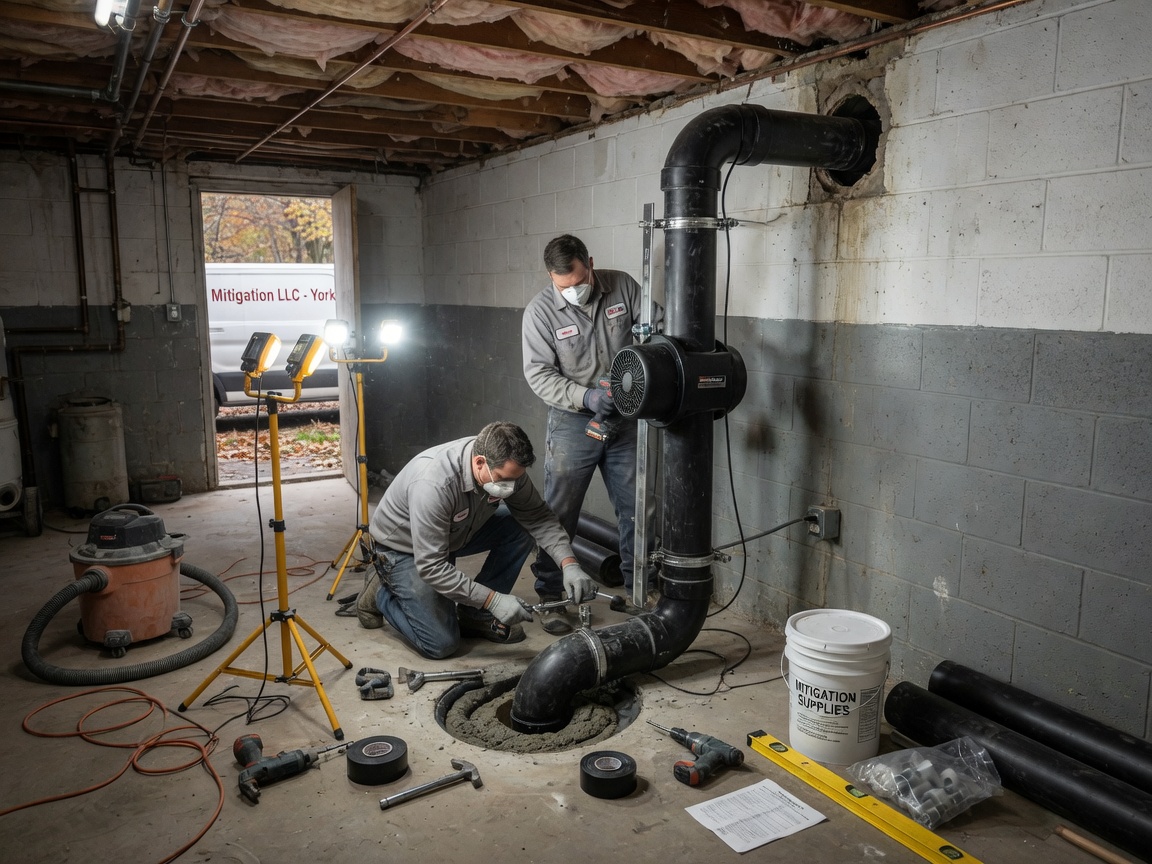
An active soil depressurization system is the standard fix for high radon in a York County home, and it is what we install most days of the week. The principle is simple: radon enters because the air pressure under your slab is slightly higher than the air pressure in your basement, so soil gas gets pushed up through cracks, the floor-wall joint, the sump pit and utility penetrations. A mitigation system reverses that. We core a hole through the slab, excavate a small suction pit in the gravel beneath it, connect a sealed PVC pipe to a continuously running inline fan, and the fan pulls soil gas out from under the house and exhausts it above the roof where it dilutes harmlessly in outdoor air.
What separates a good York install from a bad one is the diagnostic work before the drill comes out. Homes in the limestone belt through East York, Springettsbury and Manchester Township usually have a permeable gravel layer under the slab, which lets a single suction point and a mid-range fan depressurize the whole footprint. Homes on the tight red shale north toward Dover and Etters, or on fill-heavy lots in newer developments, often need a higher-suction fan or a second suction point. We measure sub-slab pressure field extension with a micromanometer at test holes across the basement before we commit to a design, so the system is sized for your ground, not for a national average.
Foundation type drives the details. Poured concrete basements are the most straightforward. Concrete block basements — common in York's 1950s–1970s housing stock — have hollow cores that fill with soil gas, so we sometimes add a block-wall suction point or seal the top course. Homes with a sump pit get a sealed, gasketed lid with a radon-resistant drain, and the pit itself often becomes the suction point, which avoids coring the slab. Split-level and combination homes with a crawl space section get a membrane-sealed sub-membrane depressurization tied into the same fan.
Every system we install follows Pennsylvania DEP mitigation requirements under 25 Pa. Code Chapter 240: a visual inspection before the bid, sealed slab and wall penetrations, urethane-caulked floor-wall joints and slab cracks, radon-resistant drains where floor drains discharge to soil, a U-tube manometer so you can see the system is running, a system label with our certification number and install date, and an exhaust terminating at least 12 inches above the roof surface and 10 feet from any window or opening. After 24 hours of operation we place a post-mitigation test and give you the written result.
Fan placement is your choice within the rules. Exterior fans mounted on a side or rear wall are the quickest install and easiest to service. Attic-mounted fans keep everything hidden — ideal for front-facing walls in York's historic districts or HOA neighborhoods in Springettsbury and York Township — and route the exhaust through the roof. Garage-attic routing is a common compromise. We walk the route with you before cutting anything.
Technician insight
The most common failure we see on other companies' York installs is an oversized fan on a porous limestone lot: it pulls conditioned air out of the basement, raises heating bills and can back-draft a gas water heater. Sizing from actual pressure-field measurements avoids it.
Radon Mitigation System Installation Services We Offer
✓Sub-Slab Depressurization
The standard active system for poured or block basements and slab-on-grade homes — one or more suction points cored through the slab.
✓Sump Pit Depressurization
Uses an existing sump pit as the suction point under a sealed, gasketed lid, avoiding a new slab penetration.
✓Block-Wall Depressurization
For hollow concrete block foundations where soil gas collects inside the wall cores; often combined with sub-slab suction.
✓Multi-Point and Large-Footprint Systems
Two or more suction points on a shared fan for larger homes, additions on separate slabs, and tight-soil lots.
✓Attic and Garage-Routed Systems
Fully concealed routing with the fan in the attic or garage attic and exhaust through the roof.
Radon Mitigation System Installation Cost in York, PA
| Service | Typical Range | What Affects It |
|---|---|---|
| Standard single-point sub-slab system | $900–$1,500 | Poured basement or slab, exterior fan, good sub-slab communication |
| Sump-pit system with sealed lid | $1,000–$1,600 | Includes gasketed lid and radon-resistant drain |
| Attic-routed concealed system | $1,400–$2,200 | Fan in attic, exhaust through roof with flashing |
| Two-suction-point system | $1,800–$2,600 | Larger footprint, block-wall or poor communication |
| Block-wall + sub-slab combination | $2,000–$3,000 | Hollow block foundations, older York City homes |
Ranges are typical for York, PA and confirmed with an exact written quote before any work starts.
Pricing
Most York County homes: $900–$2,000 for a single-suction-point system. Two suction points, block-wall or crawl space work: $1,800–$3,000.