
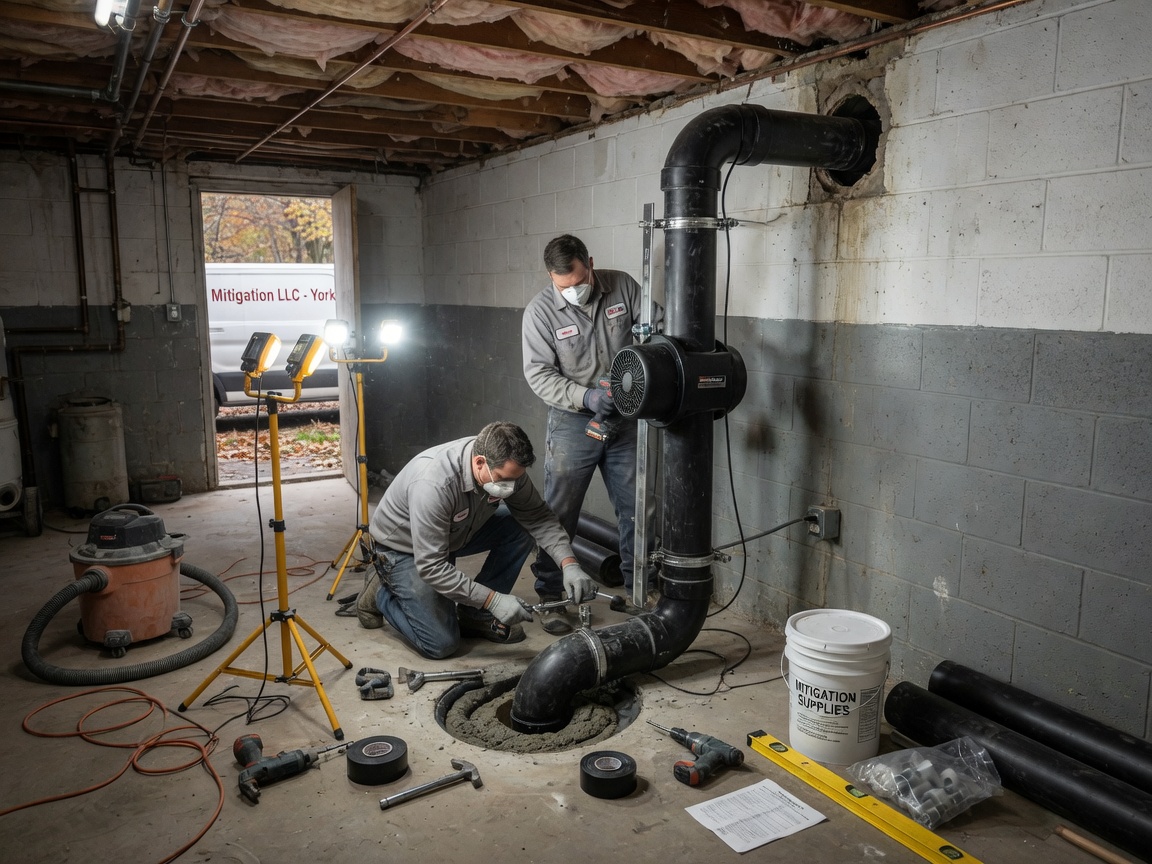
Dover borough, Dover Township and Weigelstown sit on the Triassic red shale and sandstone of northern York County — the Gettysburg basin formation that runs from Dillsburg down toward Dover and Conewago. Shale is tight, fine-grained ground with low permeability, which changes how radon behaves and how a mitigation system has to be built. Readings in Dover are often more moderate than in the limestone valley, but the soil's low permeability means that when a Dover home does test high, a standard small fan frequently cannot extend suction across the slab and the post-mitigation test disappoints.
We design Dover systems around that. A pressure-field extension test at two or three points across the basement tells us whether one suction pit will reach the far walls; if not, we open a larger pit, use a high-suction fan, or add a second suction point rather than hoping. Most of Dover's housing is 1970s–2000s ranches, bi-levels and colonials in developments off Carlisle Road, Canal Road and Davidsburg Road, mostly on poured foundations with sump pits, which makes the piping side of the install straightforward. Rural properties toward Rossville and Wellsville often have crawl spaces and private wells, and we test both when we visit.
Around Dover
We regularly work near:
- 📍Dover Area High School
- 📍Weigelstown
- 📍Brookside Park
- 📍Carlisle Road / Route 74
- 📍Canal Road corridor
Radon Mitigation in Dover — Local Notes
- •Low-permeability shale under Dover means pressure-field testing is not optional here — it decides between a $1,200 install and a $2,200 install, and we'd rather know before we drill.